SUBSCRIBE


There is something about standing on the shore of Kachemak Bay — looking out at the water with the Kenai Mountains behind it, watching the light do things to the sky that honestly seem excessive — that does something to your categories. It doesn’t just make you feel small. It makes you feel located. Placed. Like you are standing in a specific spot on a specific piece of earth that someone put there on purpose. I want to suggest something that might sound a little unusual: where you live shapes your theology. Not determines it, not replaces Scripture, but shapes it — the way a trellis shapes a vine. Most of us have constructed lives in environments that confirm what we already believe. Places where the seasons are mild and the schedules are manageable and the biggest disruption to your week is a slow internet connection. Alaska doesn’t give you that option. Psalm 19 says the heavens declare the glory of God, and the skies proclaim the work of his hands. I’ve read that verse a hundred times. I didn’t feel it the same way until I watched the aurora move across the sky on a clear January night from my driveway, or drove the highway in October when the birch trees are yellow and the mountains have their first snow and the whole thing looks like it was staged by someone who takes light very seriously. The landscape preaches here. Not in a soft, inspirational way. In a you are not running this and you never were kind of way. And that, I’ve come to believe, is exactly the kind of sermon most of us need and almost never get.
A few years back, my son Jake — about five years old at the time — and I went out fishing with a good friend of ours, the captain of the boat. We were running late getting to the harbor and in the chaos of leaving I forgot to pack lunch for Jake. Classic dad move. Before I could figure out a solution, the captain reached into his bag, pulled out his sandwich, and handed half of it to Jake without making a big deal of it. Just — here you go, kid. The weather that day was something else. Kachemak Bay was uncooperative in the way only Kachemak Bay can be, so the captain made the call to run across to Seldovia — a tiny village on the south side of the bay, no road access, quiet in the way that places with no roads are quiet — to wait it out. We got hot cocoa. I called my wife and told her we’d be home around two. And then the weather broke, the sky opened up, we got back on the water and into halibut like we’d planned the whole trip around it. We were out there until well past two with no cell service. By the time we pulled back into the harbor, my wife was in the parking lot of the harbormaster in tears. What I’ve thought about since is this: every pillar of self-management I walked onto that boat with got quietly dismantled over the course of one day. I didn’t plan for the missing lunch — someone else provided. I couldn’t control the weather — the bay made the decision. I couldn’t keep my own promise about when we’d be home. And the best fishing happened after we stopped fighting the conditions and surrendered to them. Genesis 2:18 says it is not good for man to be alone — and God said that before sin ever entered the picture. Dependency is design, not defect. Alaska has been a slow, persistent education in that direction.
There is a specific kind of quiet that Alaska produces that I haven’t found anywhere else. Not just the absence of noise — a silence that has weight to it. A silence that doesn’t flatter you or tell you what you want to hear. It just sits there, patient, unhurried, waiting for you to stop performing. I have driven out to the end of the Homer Spit on winter mornings when the fog was sitting so low on the water you couldn’t tell where the bay ended and the sky started. Just grey. Just cold. Just the sound of your own breathing and whatever is actually happening inside you that you’ve been avoiding all week. In 1 Kings 19, Elijah is at the end of himself — burned out, hiding in a cave, asking God to let him die. God sends wind, earthquake, and fire. And then the text says something remarkable: God was not in any of it. After the fire, a still small voice. A gentle whisper. That’s where God was — not in the spectacle, but in the quiet that came after. Most of us have built lives that are architecturally hostile to that whisper. We have packed every margin with something. Alaska forces a different pace, especially in winter, especially when it gets dark at three-thirty and there is nowhere to be and the silence is just there waiting. I have heard things in that quiet that I don’t think I could have heard anywhere else. Not audibly, but clearly. Things about where I was still holding on too tightly. Things that were gentle in tone but not soft in content — the kind of truth that makes you wince because somewhere underneath all the noise you already knew it.
Is the God you carry around in your daily life big enough for an Alaskan winter? I mean that as a genuine question, not a provocation. I think a lot of us — myself included for a long time — have been operating with a picture of God that is essentially a slightly larger and more competent version of ourselves. A God who fits into our preferences, confirms our convictions, and mostly stays out of the way. A God who is manageable. And then you watch a storm roll in off the Gulf of Alaska — the kind that closes the harbor and grounds the small planes — and something in that manageable picture starts to crack. Not in a scary way. In a relieving way. Because if God is big enough to run this, He is big enough to handle the things I have been quietly convinced He might be struggling with. Job 38 is one of my favorite chapters for this reason. God answers Job out of the whirlwind not with explanations but with questions: Where were you when I laid the foundation of the earth? Can you bind the chains of the Pleiades? It isn’t cruelty — it’s mercy. God is expanding Job’s frame until it’s big enough to hold what Job is going through. Living in Alaska has done that for me over and over again. The God who keeps Homer, Alaska in place — who designed the tidal patterns of Kachemak Bay and made the sky do those things in January — that God is not nervous about your situation. He is not surprised by the thing that is surprising you. When I remember that, the things I’ve been carrying start to feel like they’re in better hands than mine. Which, it turns out, they always were.
This episode is not a relocation pitch. God is not more present in Homer, Alaska than He is where you are. What Alaska has done for me is not exclusive to people who live at the end of the road system — it is an invitation to pay attention to the place you’re already in. Because every person has a Seldovia. A place they weren’t supposed to be. A detour they didn’t choose. A season where the weather didn’t cooperate and the plans fell apart and they ended up somewhere they didn’t pick, waiting for conditions they couldn’t control to change, and something happened there that couldn’t have happened anywhere else. The question is not whether those moments are happening. They are. The question is whether you are moving past them fast enough that you never let them teach you anything. We are very efficient at resolving the tension — the weather clears, we catch the fish, we go home and tell a good story. But sometimes the disruption is the sermon. The detour is the point. The thing that didn’t go according to plan is carrying more theological weight than anything that did. This week, wherever you are, find the Seldovia in your current season. The place you ended up that you didn’t plan on. Sit there for a minute instead of rushing back out. Let it be warm. Let it be quiet. And listen for what it’s trying to say — because I think you’ll find that you weren’t supposed to be there by accident, and that the best part of the story was always going to start from right there. Small ripples make a big impact. Go make yours.
Image description
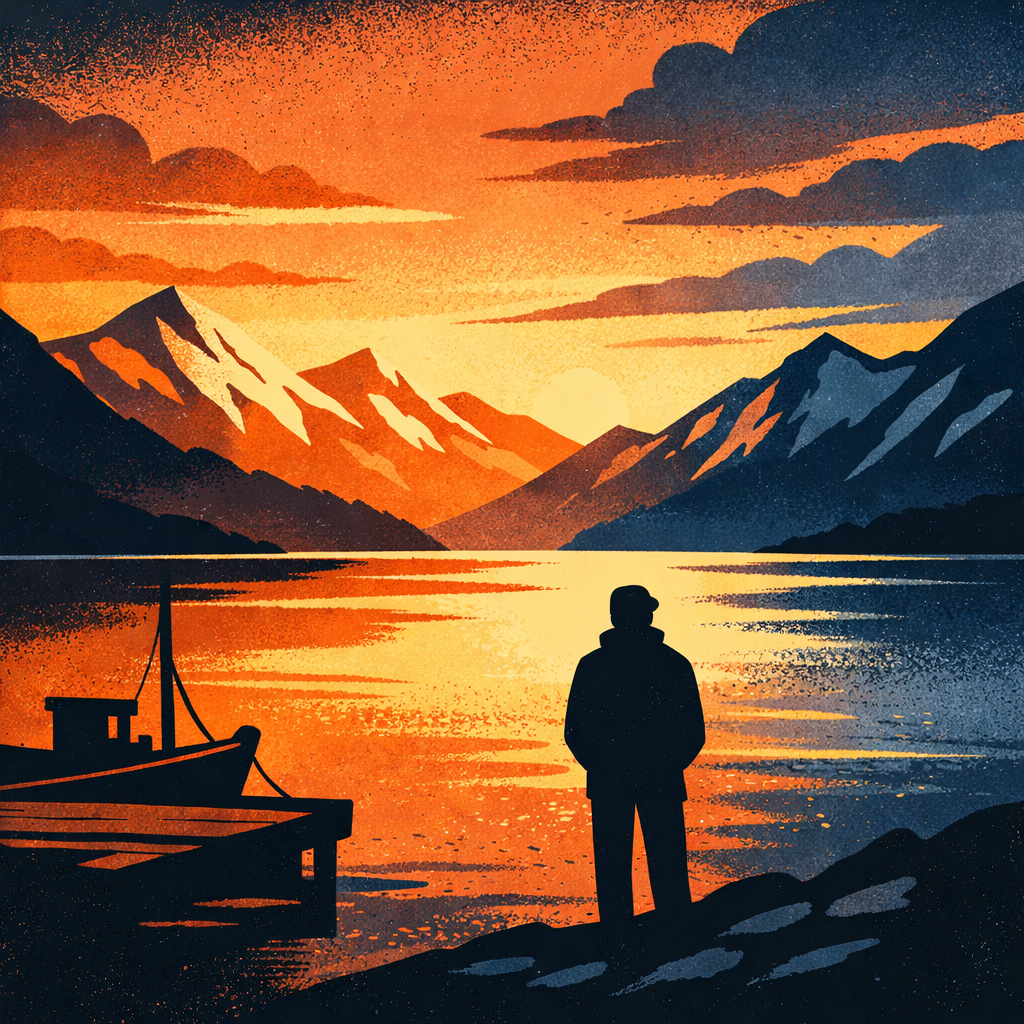
A lone figure standing at the edge of a vast body of water, small against towering mountains in the background, the sky dramatic and open above them. The lighting feels like early morning or late-afternoon Alaskan gold — warm sunset tones bleeding into cooler shadows across the water. The silhouette suggests stillness and contemplation rather than adventure — someone who has stopped moving, not someone about to set off. A small boat or dock element sits quietly in the periphery, anchoring it as a harbor or fishing scene without making that the focus. The overall mood is one of smallness that feels held rather than lonely.
Image generation prompt
A lone figure standing at the edge of a vast body of water, small against towering mountains in the background, the sky dramatic and open above them. The lighting feels like early morning or late-afternoon Alaskan gold — warm sunset tones bleeding into cooler shadows across the water. The silhouette suggests stillness and contemplation rather than adventure — someone who has stopped moving, not someone about to set off. A small boat or dock element sits quietly in the periphery, anchoring it as a harbor or fishing scene without making that the focus. The overall mood is one of smallness that feels held rather than lonely. It should be a design style characterized by bold, minimalist silhouettes that convey complex narratives through deceptively simple forms. Often uses high contrast between figure and background, with limited, deliberate color palettes — frequently moving from warm sunset tones into cooler shadows to create depth and emotional resonance. Shapes should be used not just for recognition, but for layered visual metaphors, often embedding multiple meanings within a single outline. The composition should have a cinematic feel, evoking mood and storytelling through careful framing and stark simplicity rather than detailed illustration. Texture, when used, should resemble screen-printed grain or subtle imperfections, enhancing the tactile, timeless quality of the artwork. The image should be square.

Leave a Reply